
A bath can be one of the most relaxing parts of the day, until getting in and out starts to feel uncertain. This bath lift equipment review looks at the options that can make bathing safer and more comfortable without making your bathroom feel clinical or compromising the independence you value.
A bath lift is not a one-size-fits-all purchase. The best choice depends on how you move, the shape and size of your bath, whether you need help with transfers, and how you want the room to look and work in the years ahead. For many homeowners, it is also worth considering whether a lift is the right answer at all, or whether a redesigned shower area, walk-in bath or wet room would give greater confidence every day.
What a bath lift does
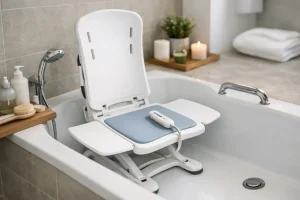
A bath lift is a powered seat that lowers a person into the bath and raises them back to the rim afterwards. Most are battery-operated and controlled by a simple handset. They are designed for people who can sit down on the bath edge but find it difficult, painful or unsafe to lower themselves into the water and stand again afterwards.
The main benefit is controlled movement. Rather than relying on strength in the knees, hips or arms, the lift supports a gradual descent and rise. This can reduce the risk of slips, ease strain for a partner or family member who would otherwise be helping, and allow someone to continue enjoying a proper bath.
However, a lift does not remove every challenge. You still need to step over the bath side to sit down, and some users may need a transfer board, grab rail or assistance to do so safely. That is why a proper assessment of the whole bathing routine matters more than choosing the most feature-packed model.
Bath lift equipment review: the main options
The most suitable equipment is usually determined by the amount of support required and the practical limits of the existing bathroom. These are the main styles homeowners tend to consider.
Standard reclining bath lifts
A standard reclining lift has a padded seat and backrest. It starts at bath-rim height, then lowers close to the bottom of the bath. The backrest reclines once the lift is down, allowing a more relaxed bathing position.
For many people, this is the most comfortable and versatile option. It gives a deeper soak than a seat that remains higher in the bath, and the reclining function can be especially welcome for anyone with stiff joints or back discomfort. Models are generally removable too, which can be useful if the bathroom is shared by several people.
The trade-off is that the seat takes up room inside the bath. It also needs regular removal or repositioning for cleaning, and the user must be comfortable with the initial sideways transfer onto the seat.
Fixed bath lifts
Fixed lifts are installed more permanently in or alongside the bath. They may use a wall-mounted mechanism or a more substantial frame, depending on the design. These can feel more secure than a portable unit and may suit users whose needs are unlikely to change.
They are often a sensible choice where consistent support is needed every day. As part of a wider mobility bathroom renovation, a fixed lift can be planned around suitable wall reinforcement, grab rails, flooring and storage, rather than treated as an isolated piece of equipment.
On the other hand, fixed equipment is less flexible if the household’s needs change or the property is sold. It should be selected carefully so that it works with the bath dimensions, access route and the overall look of the room.
Bath lifts with transfer support
Some systems are designed to make the move from wheelchair or standing position to the bath easier. They may include a swivelling seat, transfer board or side flaps that bridge the gap between the lift and the bath rim.
This type of arrangement can make a meaningful difference for someone with limited leg strength, reduced balance or restricted movement on one side. It can also make assisted bathing more manageable, provided there is enough room for a carer to work safely beside the bath.
The detail matters here. A transfer solution that is technically suitable can still be awkward if the toilet, basin or radiator leaves too little space around the bath. Measuring the room and considering how a person approaches and turns into the bathing area is essential.
Inflatable bath lifts
Inflatable lifts use connected air cushions to raise and lower the bather. They tend to be lightweight, portable and straightforward to store, making them appealing for temporary needs or bathrooms where a conventional lift is not practical.
They can be a useful lower-commitment option, but they do not suit everyone. The seating position can feel less stable to some users, and the lifting action may take longer. They also require attention to cleaning and drying, particularly in a busy family bathroom where damp equipment can become inconvenient.
Features worth paying for
Not every feature adds value for every household, but a few are worth looking at closely. A comfortable, supportive backrest matters if you enjoy longer baths. A recline function can improve comfort, while side flaps can make the transfer onto the seat feel less exposed.
Check the weight capacity with a sensible margin, not simply against the user’s current weight. Look at the battery arrangement too. A rechargeable, sealed handset should be easy to use with wet hands, and it should prevent the lift from lowering if there is not enough charge to raise it again.
Ease of cleaning is another practical consideration. Smooth, wipeable surfaces and removable covers are easier to maintain than equipment with hard-to-reach joins. If appearance matters, as it should in a home you enjoy, choose a design that can be stored neatly or incorporated thoughtfully into the room.
Is a bath lift the best long-term answer?
A bath lift can be an excellent solution when someone still loves a bath, can safely get over the bath rim and needs assistance only with lowering and rising. It can preserve a familiar daily routine with less disruption than a full renovation.
But there are circumstances where another option is likely to be better. If stepping over the bath side is already difficult, a level-access shower or wet room may offer easier day-to-day use. If warmth, privacy and bathing comfort are priorities, a walk-in bath with a low threshold and built-in seat may be more appropriate. For a household planning to remain in the property for many years, it can make sense to invest in a room designed around future accessibility rather than add equipment to a layout that is already restrictive.
This is not about making a bathroom look medical. Modern mobility bathrooms can be calm, stylish and personal, with attractive wall panels, quality brassware, practical storage and lighting that makes the room easier to use. Good design simply anticipates what will make life more comfortable.
Questions to answer before choosing
Before ordering any bath lift equipment, consider the full sequence of use. Can the person approach the bath safely? Can they sit on the rim and transfer onto the seat? Is there a secure place for a grab rail if one is needed? Will a partner or carer have enough space to assist without twisting or reaching awkwardly?
It is also sensible to think beyond the lift itself. Non-slip flooring, well-positioned lighting, an easy-to-reach shower control and a thermostatic valve all contribute to a safer bathing space. A single product can help, but the room works best when its parts support one another.
For homeowners around St Neots and Cambridgeshire, The Bathroom Magician can help assess whether a bath lift, walk-in bath, shower conversion or fully considered mobility bathroom is the most practical fit for your home. No jargon. No stress.
The right choice should leave you feeling reassured before you turn on the taps. Whether that means retaining the bath you know or redesigning the room around easier access, start with how you want to live in the space, not just the equipment you think you need.