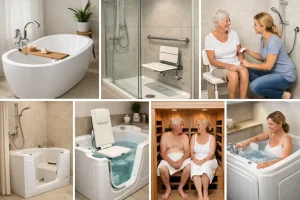

A walk-in bath sounds like the obvious answer when bathing starts to feel less comfortable or less safe. But for many homeowners, walk-in bath alternatives make more sense once you look at how the bathroom is actually used day to day, how much space you have, and whether you want a solution that feels clinical or simply well designed.
That is usually the real question. Not just, “What helps with access?” but, “What will work well for me now, still look right in my home, and not make everyday life harder?” A good bathroom design should support independence, reduce risk and still feel like part of the home – not a compromise.
Why many homeowners look beyond a walk-in bath
Walk-in baths can be a useful option in the right setting, but they are not always the best fit. One of the biggest drawbacks is practical rather than visual. You need to get into the bath before it fills and wait for it to empty before you can get out. For some people that is manageable. For others, especially in a cooler room or if comfort is already an issue, it can become frustrating quite quickly.
Space is another factor. Walk-in baths can be bulky, and in smaller bathrooms they may dominate the room. That can leave less space for easier movement, storage or support features that are just as important as the bath itself.
Cost matters too. If your main goal is safer washing, there may be better ways to achieve it without committing to a specialist bath that takes up most of the room. In many cases, the best answer is not one product but a better planned layout.
The best walk-in bath alternatives depend on how you live
The right solution depends on whether you want easier showering, safer bathing, more room to move, or a bathroom that can adapt with you over time. That is why a like-for-like swap is not always the smartest route.
A carefully designed bathroom can blend accessibility features into a space that still feels stylish and easy to maintain. That might mean removing a bath entirely, reshaping the room around a shower, or choosing fittings that give support without making the room look institutional.
1. A low-level walk-in shower
For many households, a low-level shower is the strongest alternative to a walk-in bath. It reduces the height you need to step over, makes access simpler and can be tailored with practical extras such as grab rails, fold-down seating and easy-use controls.
This option works particularly well if bathing itself is becoming difficult but you still want a comfortable daily routine. A shower enclosure can be designed to feel open and spacious, or more enclosed if warmth and splash control are priorities. With the right tray and screen, it can look sleek rather than medical.
It is also easier to clean than many people expect, especially when large wall panels or minimal grout lines are part of the design.
2. A wet room
A wet room is often the most future-ready choice. Instead of stepping into a tray or climbing into a bath, you walk straight into the showering area on a level floor. That creates excellent accessibility and a strong sense of space, which is especially helpful in smaller bathrooms.
For homeowners thinking long term, wet rooms are worth serious consideration. They allow better movement, support mobility needs and can be designed with discreet slip-resistant flooring, drainage and shower screens that do not make the room feel boxed in.
That said, a wet room has to be designed and installed properly. Floor gradients, waterproofing and drainage all need expert handling. Done well, it is one of the smartest and most elegant walk-in bath alternatives available. Done badly, it can cause ongoing problems.
3. A bath with a lower side entry
If giving up a bath completely feels like too much of a change, a standard or compact bath with a lower edge can be a more balanced option. This does not remove the step entirely, but it can make entry easier than with a deeper traditional bath.
It is often suitable for homeowners who still enjoy bathing and do not yet need a fully adapted solution. You can combine it with sturdy grab rails, well-placed taps and anti-slip flooring to make the overall space safer.
This route is less specialised, which can also help if you want the bathroom to appeal to different family members or future buyers.
4. A bath with a powered seat or lift support
Some people want to stay with a bath because it is more comfortable for aching joints or because it is part of a familiar routine. In those cases, a bath lift or powered seat may be worth considering.
This can be a good middle ground if the shape of your bathroom still suits a bath and the main difficulty is lowering yourself in and out. It avoids replacing the whole room immediately, although it does mean introducing equipment into the space, which not everyone likes from a visual point of view.
It is also worth thinking about whether this is a short-term answer or part of a longer-term bathroom plan. Sometimes support equipment works best as a stepping stone before a fuller renovation.
5. A walk-in shower with seating
There is a difference between a basic shower and one designed for comfort. Built-in or fold-down seating can make showering safer and more relaxing, especially if standing for long periods is tiring.
This option suits homeowners who want the room to look polished and contemporary while quietly building in more support. Seating can be integrated neatly, and when combined with thermostatic controls, handheld shower options and sensible storage, the whole room becomes easier to use without shouting about accessibility.
For many of our clients, that balance is exactly what they are looking for.
6. A tub-to-shower conversion
If your current bath is rarely used, replacing it with a shower can transform how the room works. A tub-to-shower conversion is one of the most practical walk-in bath alternatives because it makes better use of the footprint you already have.
This can open up the bathroom, improve access and create more usable space around the basin and WC. It often suits older properties around St Neots and Cambridgeshire, where bathrooms can be compact and every bit of floor space matters.
The key is not just removing the bath, but redesigning the room properly around the new shower. That includes choosing the right enclosure, flooring, wall finish and storage so the finished space feels intentional rather than patched together.
7. A fully planned mobility bathroom
Sometimes the best alternative is to stop thinking about one item and start thinking about the whole room. A mobility bathroom can include a level-access shower, wider clearance areas, support rails, easy-turn brassware, comfort-height sanitaryware and practical lighting.
This kind of approach works well when several small difficulties are adding up. Maybe stepping into the bath is one issue, but so is slippery flooring, awkward layout or not enough support near the toilet or basin. A full redesign deals with those points together.
That often gives better long-term value than buying one specialist product and hoping it solves everything.
What should you consider before choosing?
The first thing is how the bathroom is used now, not how it used to be used. If a bath is sitting there because it has always been there, that is not really a reason to keep it. Equally, if a bath is still important for comfort or wellbeing, there may be ways to keep that experience while making the room safer overall.
Think about who uses the bathroom, how long you plan to stay in the property, and whether you want a solution that supports changing needs. Safety matters, but so do warmth, cleaning, appearance and ease of use. The best bathroom is the one that feels natural every single day.
Budget also needs honest thought. In some cases, a simpler shower conversion is enough. In others, investing in a properly designed wet room or mobility bathroom avoids having to change things again later.
Good design matters as much as the product
This is the part many people miss. The success of any alternative comes down to design and installation. You can choose the right type of shower or bath, but if the layout is awkward, the flooring is slippery or the controls are badly placed, the room still will not work as it should.
A well-planned bathroom should feel easy from the moment you walk in. Clear space where you need it. Support where you need it. Finishes that are durable and simple to maintain. And importantly, a look that still feels like your home.
That is why a managed approach often makes things easier. Rather than piecing together products and hoping they fit, you can plan the room around your lifestyle from the start. At The Bathroom Magician, that usually means helping homeowners find a solution that improves comfort and safety without losing the style and quality they want from a proper renovation.
If you are weighing up walk-in bath alternatives, the best next step is not choosing a product from a brochure. It is working out what kind of bathroom will make daily life feel easier, safer and more comfortable for years to come.