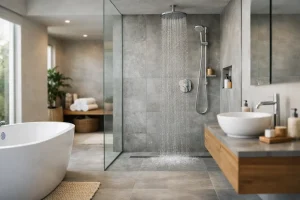

If you have ever stepped into a bathroom where the floor runs level into the shower area, with no tray and often no enclosure, you have already seen the answer to the question: what is a wet room? Put simply, a wet room is a fully waterproofed bathroom where the shower area is built into the room itself, rather than added as a separate cubicle.
That sounds simple enough, but the real difference is in how it is designed and installed. A proper wet room is tanked – which means the floor and walls are sealed to stop water escaping into the structure of your home – and the floor is laid to a gentle fall so water drains away efficiently. Get that right, and you have a bathroom that looks sleek, feels spacious and works brilliantly day to day.
What is a wet room in practical terms?
The easiest way to think about it is this: a wet room turns part or all of your bathroom into the shower space. Instead of stepping over a shower tray, you walk straight onto a tiled or panelled floor that has been carefully prepared underneath. Water flows towards a drain built into the floor, and the surrounding surfaces are made to cope with regular soaking.
Some wet rooms are completely open-plan, while others use a glass screen to stop too much splashing. Both count as wet rooms if the room has been waterproofed correctly and the shower area is integrated into the floor.
This is why a wet room is not just a shower without a tray. It is a different construction method altogether. The waterproofing, drainage and floor preparation are what make it work.
Why homeowners choose wet rooms
For many homeowners, the appeal starts with the look. Wet rooms have a clean, uncluttered finish that can make even an ordinary bathroom feel more contemporary. Because there is no raised tray or bulky enclosure, the room often feels bigger and calmer.
There is also a practical side. A well-designed wet room is easier to move around in, easier to clean in many cases, and can be a very sensible choice for anyone planning for later life or needing better accessibility now. With level access and fewer barriers, it can be safer and more comfortable than a standard shower setup.
That said, wet rooms are not only for mobility bathrooms. Families like them because they are straightforward to use, and many people simply prefer the open feel. In smaller bathrooms, a wet room can make the best use of available space. In larger bathrooms, it can create a more luxurious, hotel-style finish.
The main benefits of a wet room
One of the biggest advantages is space. Removing the tray and enclosure can open up the room visually and physically. In compact bathrooms, that can make a surprising difference.
Another is accessibility. If someone in the household finds stepping over a bath side or shower lip awkward, a level-entry shower area can be far more practical. It supports independent use and can future-proof the home without making the bathroom feel clinical.
Maintenance is another reason people consider them. With fewer edges, frames and awkward corners, there is often less for grime and limescale to gather around. That does not mean no cleaning, of course, but it can mean a simpler routine.
Then there is the design flexibility. Wet rooms can be finished in tiles, wall panels or a combination of both, with drains and screens chosen to suit the style of the room. Done well, they feel bespoke because they are bespoke.
Are there any downsides?
Yes – and it is always better to be honest about them.
First, installation matters more than ever. A wet room is only as good as its waterproofing and drainage. If corners are cut, problems can show up later in the form of leaks, poor drainage or standing water. This is not the sort of bathroom feature where a quick fix will do.
Second, the room layout needs careful thought. In some bathrooms, an open shower area works beautifully. In others, water can travel further than expected unless a screen is positioned properly and the floor is set out with care. The right design prevents the whole room from feeling permanently damp.
Third, cost can be higher than a standard shower replacement. That is because more groundwork is involved, especially if the floor needs adjusting to create the correct fall to the drain. If you are already carrying out a full renovation, that can be easier to accommodate. If you are changing only one element of the bathroom, it may be less straightforward.
What is a wet room best suited to?
Wet rooms work particularly well in homes where practicality matters just as much as appearance. If you are refurbishing your long-term home and want something that will still suit you years from now, a wet room is often worth considering.
They are also a strong option for en suites and smaller bathrooms where every inch counts. By simplifying the layout, you can make the room feel less cramped.
For accessible bathrooms, they make even more sense. Level access, room to manoeuvre and thoughtful placement of grab rails or seating can turn a bathroom into a safer, more comfortable space without losing style.
But suitability does depend on the property and the room. Timber floors, awkward drainage runs or very tight layouts are not deal-breakers, but they do need proper planning. That is why it helps to treat a wet room as a design and installation project, not just a product choice.
How a wet room is built
This is where expertise counts.
The existing room is usually stripped back so the floor and walls can be prepared properly. A former or pre-shaped floor section may be fitted to create the slope towards the drain. The room is then tanked so moisture cannot get into the subfloor or walls. After that, the visible finishes go on – tiles or wall panels, drainage detail, screen if needed, and the shower fittings themselves.
Every part has to work together. The floor gradient needs to be enough for drainage but comfortable underfoot. The drain needs to cope with the water flow. The finishes need to be fitted neatly and sealed correctly. Even the choice of tile matters, because slip resistance and grout maintenance both affect daily use.
That is why many homeowners prefer a fully managed service rather than trying to coordinate separate trades. Good wet rooms are planned carefully from the start.
Wet room or standard shower?
If you are weighing up your options, the answer usually comes down to budget, layout and how you want the room to feel.
A standard shower enclosure is often the simpler and less expensive route. It keeps water tightly contained and can be ideal if you want a straightforward update.
A wet room offers more openness, easier access and a more tailored finish, but it needs more detailed installation. If you are already investing in a full bathroom renovation, the gap in effort may not feel as large because the room is being reworked anyway.
For homeowners around St Neots and across Cambridgeshire, this is often the key question: are you looking for a quick replacement, or do you want the bathroom to be redesigned around how you actually live? If it is the latter, a wet room becomes a much more attractive option.
How much does a wet room cost?
There is no honest one-price answer, because costs vary with room size, drainage requirements, chosen finishes and whether you are converting an existing bathroom or starting from scratch.
In general, a wet room costs more than fitting a standard shower tray and enclosure. The waterproofing and floor work add to the labour and materials. Premium tiles, bespoke glass screens and high-end brassware will increase the budget further.
But value is not only about the upfront spend. A wet room can improve usability, make a compact room work harder and create a finish that feels properly considered. For many homeowners, that is worth the investment.
Is a wet room right for you?
If you want a bathroom that feels modern, open and easy to use, there is a lot to like. If accessibility is a priority, it can be one of the smartest choices you make. If your main concern is keeping costs as low as possible, a standard shower may be the better fit.
The best answer usually comes from looking at the room as a whole – the space you have, the people using it, and how long you expect it to serve your home. At The Bathroom Magician, that is exactly how we approach bathroom design: no jargon, no stress, just practical advice and a finish that works beautifully in real life.
A wet room is not for every bathroom, but when it is planned properly, it can be one of the most comfortable and hard-working upgrades you can make to your home.