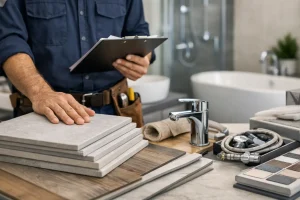

A new bathroom can involve far more than fitting a shower, bath and toilet. Tiles, boards, pipework, taps, lighting, sealants and finishing touches all need to arrive at the right time. So, do bathroom fitters supply materials? Often, yes – but the answer depends on whether you have chosen a fully managed renovation or a labour-only installer.
For homeowners around St Neots and Cambridgeshire, the clearest route is usually a bathroom specialist that designs, supplies and installs the whole room. It means one team takes responsibility for the practical details as well as the finished look. No jargon. No stress.
Do bathroom fitters supply materials as standard?
Some bathroom fitters supply everything required for the project, while others quote for labour only and ask you to source the products yourself. Neither approach is automatically wrong, but they create very different experiences.
A fully managed bathroom company will normally help you select the visible items – such as sanitaryware, furniture, shower screens, brassware, tiles and wall panels – then order them on your behalf. It should also provide or arrange the less glamorous essentials needed behind the scenes, including adhesives, grout, sealant, fixings, waste pipes, valves, waterproofing systems and suitable boards.
A labour-only fitter may be an option if you are confident choosing every product, can check compatibility, and have somewhere dry and secure to store deliveries. However, the responsibility for ordering the right quantities and resolving any missing or damaged items is likely to sit with you. A delayed shower tray or the wrong tile trim can hold up the whole job.
The key is not to assume. Ask exactly what the quotation covers before work is booked.
What a complete bathroom supply and fitting service usually includes
Every project is different, particularly in older homes where existing plumbing or uneven walls can affect the scope. Still, a properly planned, end-to-end service commonly covers product guidance, measurement, ordering, delivery coordination and installation alongside the materials themselves.
Bathroom products you can see and choose
These are the items that shape how the room looks and works each day. Your fitter or designer may supply the bath or shower enclosure, toilet, basin, vanity unit, taps, shower, heated towel rail, mirrors, lighting and accessories.
This is where showroom advice is especially useful. A compact en-suite may benefit from a slimline vanity unit and quadrant enclosure, while a family bathroom might need generous storage and hard-wearing surfaces. For a mobility bathroom, the priority may be a level-access shower, supportive fittings and easy-to-use controls. The best choices are not simply the most expensive ones – they are the ones that suit the room and the people using it.
Tiles, wall panels and flooring may also be included. Be clear whether your quoted tile allowance covers the purchase price only, or also includes trims, adhesive, grout and preparation materials. Those details matter to both the budget and the finish.
The materials hidden behind the finish
Much of a long-lasting bathroom is never seen once the project is complete. Sound preparation can include moisture-resistant wall boards, tanking or waterproof membranes around showers, floor levelling compounds, new pipework, electrical cabling and ventilation components.
These materials are not glamorous, but they should not be treated as optional extras simply to make an initial quote look cheaper. A beautiful shower area still needs proper waterproofing beneath its tiles. Likewise, a new vanity unit needs secure fixings and suitable connections, not a quick workaround based on what happens to be in the van.
An experienced installer will assess what is required once the room has been measured and the design agreed. If the condition of the existing bathroom cannot be fully known until it is stripped out, they should explain that possibility in advance and set out how unforeseen work will be handled.
Delivery, checks and replacements
When a company supplies the materials, it should manage the ordering timetable so products arrive before they are needed, without filling your home with boxes weeks too early. They should check items for obvious damage and confirm key pieces are correct before installation begins where possible.
There can still be supplier delays or manufacturing faults. The difference is who has to spend time chasing the replacement. With a managed service, your bathroom company should be your main point of contact, rather than leaving you to speak to several retailers while an unfinished room sits unusable.
What may not be included in the original price
Even an all-inclusive sounding quote can contain assumptions, so it pays to read the detail rather than compare only the final figure. Some items may be excluded because they are personal choices, unknown until work starts, or outside the fitter’s usual scope.
Common examples include painting outside the bathroom area, major building alterations, specialist electrical upgrades, asbestos removal, moving soil pipes over a significant distance, and repairing serious hidden damage. Decorative extras such as a particular mirror, niche lighting or premium tile range may be listed as an allowance rather than a fixed product.
An allowance is not necessarily a warning sign. It can be a sensible way to begin planning before you have chosen every finish. What matters is that you know the allowance amount, what products it is based on, and what happens if you select something above or below it.
Questions to ask before you accept a bathroom quote
A dependable fitter will welcome straightforward questions. You do not need trade knowledge to get clear answers. Before committing, ask for the quote to confirm these points:
- Which bathroom products are supplied, including makes, models, sizes and finishes.
- Whether tiles, panels, flooring, trims, adhesive, grout, sealant and waterproofing are included.
- Who orders the materials, checks deliveries and deals with damaged or incorrect items.
- What preparation work is allowed for, and how any hidden problems or changes will be priced.
- Whether waste removal, final cleaning and disposal of packaging are included.
Also ask about guarantees. Product warranties are usually provided by the manufacturer, while workmanship should be covered by the installer. Keeping this distinction clear helps you understand who to contact if an issue arises later.
Is it cheaper to buy your own bathroom materials?
Buying products yourself can look cheaper when you spot a sale online, but the saving is not always as simple as it appears. You may need to pay for delivery, returns, storage and replacement parts. More significantly, an item that looks right in a photograph may not work with your chosen waste, shower valve, wall depth or room layout.
There is also the question of accountability. If a customer-supplied product arrives damaged, is incomplete, or fails during installation, the fitter may need to pause work and charge for a return visit. If it is not suitable for the planned installation, responsibility can become unclear.
That said, some homeowners enjoy sourcing a statement mirror, vintage cabinet or a very specific tap themselves. This can work well when it is agreed at the design stage. Give your fitter the full product details early, rather than ordering it after the installation has started.
For most complete renovations, having one specialist coordinate products and fitting is worth considering. The Bathroom Magician combines design guidance, carefully selected bathroom products and skilled installation so the practical pieces are planned alongside the visual ones. That helps avoid a room that looks good on paper but creates awkward compromises when it comes to fitting it.
The value of one team from design to fitting
Supplying materials is not just about delivering boxes. It is about making sure every element belongs in the same plan. The shower tray must suit the enclosure, the furniture must fit around the pipework, the wall finish must be appropriate for wet areas, and the layout must leave enough comfortable space to move around.
A complete service also makes decision-making less draining. Instead of trying to coordinate a retailer, plumber, tiler, electrician and delivery driver, you have one team guiding the project. That is particularly reassuring when a bathroom is your only one, or when the design needs to support changing mobility needs.
A good bathroom quote should leave you feeling clear about what will be supplied, what you need to decide, and who is responsible at every stage. Ask for that clarity early, choose materials that genuinely suit your home, and you can look forward to the finished room rather than worrying about the next delivery.