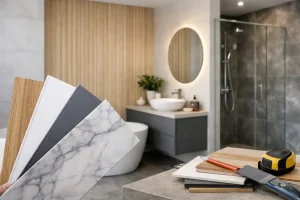

A bathroom wall panelling guide should do more than show you a few attractive finishes. It should help you avoid costly mistakes, understand what works in a real home, and choose something that still looks good after years of daily use. That matters even more when you are renovating a family bathroom, updating an en suite, or planning a safer and easier-to-maintain space for later life.
Wall panelling has become a popular alternative to traditional tiling, and it is not hard to see why. It can give a bathroom a clean, polished look with far less grout to maintain. In many cases, it also speeds up installation and creates a more watertight finish around showers and baths. But like most bathroom choices, the right option depends on how the room is used, the condition of the walls, and the standard of finish you want.
Why homeowners choose bathroom wall panelling
The main appeal is practicality. Tiles can look beautiful, but they involve joints, grout lines and more time on site. Panelling offers a smoother surface, which often means less cleaning and fewer places for mould and grime to build up. For busy households, that is a real advantage.
There is also a design benefit. Panels can create a sleek modern feel, a softer spa-style finish, or even the look of stone, marble or timber without some of the drawbacks of the real material. If you are trying to make a compact bathroom feel calmer and less visually busy, large panels with minimal joins can help.
For accessibility-focused bathrooms, panelling can make even more sense. A clean wall finish is easier to wipe down, and when combined with a walk-in shower or wet room design, it supports a simple, practical space that does not feel clinical.
Bathroom wall panelling guide to the main panel types
Not all wall panels are the same. This is where many homeowners get caught out, because the look may seem similar at first glance, while the quality and lifespan can vary quite a lot.
PVC bathroom panels
PVC panels are often chosen because they are cost-effective and quick to fit. They are lightweight, available in a wide range of finishes, and can work well in standard bathrooms where budget matters. Some are better quality than others, though, and cheaper options can look less convincing up close.
If you want a straightforward update without the cost of full tiling, PVC can be a sensible choice. The trade-off is that it may not deliver the same premium feel as more substantial panel systems.
Composite or laminate panels
These tend to offer a more solid, higher-end finish. They often come in larger sheets and can replicate natural materials very effectively. Many homeowners choose them for shower enclosures, feature walls, or full-room schemes where they want a more luxurious appearance without the maintenance of stone or extensive grout.
They usually cost more than basic PVC, but they can be a better long-term investment if appearance and durability are high priorities.
Acrylic and high-gloss panels
These are popular in contemporary bathrooms, especially where light reflection helps a smaller space feel bigger. They can look very smart, but the style is quite specific. If your home leans more traditional, they may feel a little too sleek.
As with all glossy finishes, water marks and smears may show more readily, so they suit homeowners who like a crisp, polished look and do not mind regular wiping.
Where panelling works best
One of the biggest misconceptions is that wall panelling has to be used everywhere. In reality, it often works best when chosen with purpose.
In shower areas, panelling is especially practical. This is the zone that sees the most water, the most cleaning, and often the quickest wear. Large waterproof panels can reduce weak points and create a neater finish.
Behind a bath, panelling can also make sense, particularly if children use the space or if the bath includes a shower over it. In cloakrooms or downstairs WCs, panelling can create impact quickly and with less disruption. In larger bathrooms, mixing panelling with paint or tiles can give you a more balanced design.
That is why good bathroom design is rarely about one material replacing another entirely. It is about using each finish where it performs best.
Style matters as much as maintenance
A bathroom has to work hard, but it should still feel right for your home. The best panelling choices do not just solve practical problems. They improve the overall feel of the room.
Marble-effect panels remain popular because they bring light and elegance without demanding too much upkeep. Soft stone finishes work well in calm, neutral schemes. Timber-look panels can add warmth, although they need to be chosen carefully so the effect feels refined rather than overly rustic.
Colour also plays a part. Pale finishes can open up a smaller bathroom, while darker panels can add depth and a boutique-hotel feel. The important thing is balance. A finish that looks striking in a showroom may feel overpowering in a narrow room with limited natural light.
This is often where expert guidance helps. Seeing samples in person, against flooring, brassware and furniture choices, gives you a much clearer idea of what will work in the space as a whole.
What to consider before you choose
A good bathroom wall panelling guide should be honest about the decisions behind the finish. It is not just about what looks nice on a board.
Start with the room itself. Is it a busy family bathroom, a guest en suite, or a mobility bathroom where ease of cleaning and durability are especially important? The more heavily the room is used, the more worthwhile it is to invest in quality materials.
Next, think about the walls underneath. Panels can sometimes be fitted over existing surfaces, but only if those surfaces are sound, level and suitable. If the room has underlying damp issues, poor plasterwork or older finishes that are failing, those problems need sorting first.
Then there is the matter of joins, trims and edges. These details have a huge effect on the final appearance. A well-designed and professionally installed panel system can look crisp and high end. A rushed job with awkward joins will never quite feel finished.
Installation is where quality shows
This is one area where cutting corners tends to show quickly. Bathroom wall panelling can look deceptively simple, but accurate measuring, preparation and sealing make all the difference.
In shower spaces especially, the installation has to be watertight. Panels need to sit properly around trays, baths, niches, valves and screens. If those details are handled poorly, you may end up with water ingress behind the finish, which is exactly what you were trying to avoid.
Professional installation also helps with the broader design. Panel layout, matching patterns, trim placement and the relationship with flooring or sanitaryware all affect how polished the room feels. In a well-planned renovation, these things are considered from the start rather than treated as afterthoughts.
For homeowners who want a stress-free project, that joined-up approach is often the real value. It means the walls, showering, storage, lighting and finishing details all work together.
Cost versus long-term value
Panelling can be cost-effective, but it is not always the cheapest route overall, and cheapest is not always best. Material quality, the area being covered, wall preparation and the complexity of the room all affect the final price.
A basic panel system in a simple bathroom may come in lower than a fully tiled scheme. A premium large-format panel with detailed installation may cost more upfront, but save time on fitting and reduce maintenance later. That is why price on its own is not the best comparison.
A better question is whether the finish suits how you live. If you want easy cleaning, fewer grout lines, a fast turnaround and a neat modern appearance, panelling can offer excellent value. If you love intricate tile patterns and period detail, tiles may still be the better fit in some parts of the room.
Is bathroom wall panelling right for your home?
For many homes, yes. It is practical, stylish and often easier to maintain than traditional tiled walls. It works particularly well in shower areas, family bathrooms and accessible spaces where simplicity and durability matter. But the right answer depends on the room, the finish you want, and the standard of installation.
At The Bathroom Magician, this is usually where a managed design-and-installation service helps most. Rather than choosing panels in isolation, homeowners can look at the full picture – layout, storage, safety, ease of cleaning and overall style – and make decisions that work for everyday life as well as the finished look.
If you are considering wall panelling, take your time with the choice. Good bathrooms are not built around trends alone. They are built around how you use the space, how long you want it to last, and how easy you want it to be to live with every day.