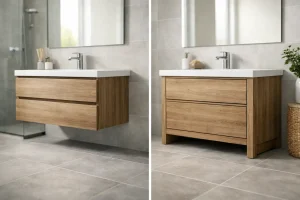

A vanity unit has a bigger effect on a bathroom than its footprint suggests. It determines where towels, toiletries and cleaning products live, how easy the floor is to clean, and even whether the room feels open or enclosed. When deciding on a wall-hung versus floorstanding vanity, the right answer is rarely just about appearance. It is about the way your household uses the room every day.
A wall-hung unit can give a compact en-suite a lighter, more spacious feel. A floorstanding vanity can bring reassuring storage and suit walls where mounting a heavy unit is not practical. Both can look beautifully finished when they are selected for the room, rather than simply chosen from a display.
Wall hung versus floorstanding vanity: the key difference
A wall-hung vanity is fixed to the wall with clear space beneath it. It appears to float above the floor, usually at a height chosen to suit the people using the bathroom. A floorstanding vanity sits directly on the floor, either on a full plinth or on legs, so its weight is supported from below as well as secured against the wall.
The visual difference is immediate, but the practical difference matters more. A wall-hung unit relies on a suitable wall and professional fixing. A floorstanding unit is generally more forgiving where the wall construction, pipework position or overall layout limits the available options.
Neither type is automatically better. The best choice depends on the size of the bathroom, the condition of the walls, the amount of storage you need and how you want the space to feel once it is complete.
Why homeowners choose a wall-hung vanity
Wall-hung vanities are popular in contemporary bathroom schemes because they create visible floor space. In a small bathroom, cloakroom or en-suite, being able to see the flooring continue beneath the unit can make the room appear wider and less crowded. This is especially effective with large-format tiles or continuous flooring, where fewer visual breaks create a calmer finish.
Cleaning is another genuine advantage. With no cabinet base on the floor, you can sweep or mop underneath without working around plinths, legs or awkward corners. That can be particularly helpful in a busy family bathroom, where toothpaste splashes, hair and dust somehow find every edge of the room.
A wall-hung vanity also gives greater flexibility over height. Standard heights work well for many homes, but a bespoke bathroom design can position the basin unit at a more comfortable level for taller users or make considered allowances for accessibility. This does need careful planning around the basin, mirror, taps and waste pipes, but it can make everyday use noticeably more comfortable.
The trade-off is installation. A substantial vanity, particularly one with a stone worktop or a double basin, must be fixed securely to a wall capable of carrying the load. Solid masonry walls are often straightforward, while stud walls may need strengthening behind the plasterboard before the unit is fitted. This is not a reason to rule out wall-hung furniture, but it is a reason to have the installation assessed properly before committing to a design.
Wall-hung units may also offer slightly less internal storage at the same overall width. Their shallower depth and raised format are excellent for keeping a room feeling light, but families with a large collection of bathroom essentials may need to be more selective about drawer layout, tall storage and mirrored cabinets.
When a floorstanding vanity makes more sense
Floorstanding vanities have moved well beyond bulky, traditional cabinet units. Modern options can be slim, elegant and handleless, with finishes ranging from warm wood effects to painted matt colours and textured surfaces. They can suit classic, contemporary and country-inspired bathrooms equally well.
Their strongest advantage is storage. Because the cabinet reaches the floor, you often gain additional usable volume for larger bottles, spare toilet rolls, cleaning supplies and folded towels. Deep drawers are particularly practical, as they bring contents forward rather than leaving items lost at the back of a cupboard.
They are also a sensible choice when wall conditions are uncertain. Although floorstanding furniture should still be secured to the wall, the floor takes much of the unit’s weight. This can simplify the fitting process in older properties, rooms with lightweight partition walls or bathrooms where major wall alterations are not part of the plan.
For some homeowners, a floorstanding vanity simply feels more substantial. If you are renovating a long-term family home and want furniture that feels grounded and generous, that solid presence can be part of the appeal. It can also work well beneath a wider basin, where a larger unit helps balance the proportions of the room.
The compromise is cleaning. A full plinth leaves a line where the unit meets the floor, and units on legs create areas around the feet that still need attention. Good installation and neat sealing help prevent dirt and moisture collecting at the edges, but a wall-hung design will usually remain the easier option for cleaning the entire floor.
Storage, layout and daily routines
Before choosing a style, think about what currently ends up around your basin. If the worktop is crowded with skincare, electric toothbrushes, hair products and children’s bath items, storage should lead the decision rather than follow it.
Drawer-led vanities are often the most useful format, whether wall hung or floorstanding. They make smaller items easy to find and can include internal dividers for a tidier routine. Cupboard units can be better for taller bottles or bulky cleaning products, while a combination of drawers and a tall cabinet may suit a shared family bathroom.
Consider the clearance around the unit too. A deeper floorstanding vanity can provide excellent storage, but it should not make the route between the door, shower and toilet feel tight. In a narrow room, a reduced-depth vanity may be more valuable than extra cupboard space. A good bathroom plan considers how doors and drawers open, where people stand to use the basin, and whether two people can move around the room comfortably.
Style, proportion and the finish of the room
Wall-hung furniture tends to support a clean, modern look, especially when paired with a wall-mounted basin mixer, a large mirror and tiled flooring that runs beneath the unit. It is often the natural choice for a minimal scheme or a compact room where visual space is at a premium.
Floorstanding furniture can create more of a furniture-like feel. A fluted front, framed door, painted finish or wood-effect cabinet can introduce warmth and character, particularly in a period property or a bathroom designed to feel less clinical. This does not mean it has to look traditional. A simple floorstanding unit in a soft neutral tone can be every bit as contemporary as a floating design.
Colour and worktop choice can shift the effect of either option. Dark cabinetry gives a confident, luxurious look but may feel heavy in a poorly lit room. Lighter finishes can lift a smaller bathroom, while natural timber tones add warmth without overwhelming the space. The basin shape, handles, taps and lighting should all be considered together, rather than as separate decisions.
Accessibility and future comfort
For a mobility-focused bathroom, wall-hung vanities can offer useful clear floor space beneath the basin. This may make the room easier to navigate and can be helpful where a seated user needs closer access. However, the final height, projection and basin shape must be chosen carefully, as accessibility needs vary widely.
A floorstanding unit can also be the right choice where maximum storage is needed for care products, towels or household supplies. In either case, easy-grip handles, soft-close drawers, clear lighting and sensible positioning are often more important than the furniture type alone.
Planning for future comfort does not mean compromising on style. It means making sure the bathroom continues to work well as routines and needs change.
Make the choice with the room in front of you
The most successful bathroom furniture is not chosen in isolation. Wall strength, pipework, floor levels, tile layout, basin height and storage habits all influence whether a wall-hung or floorstanding vanity will serve you best. Seeing finishes and sizes in person also helps, as a unit that looks compact online can feel very different in a real room.
At The Bathroom Magician, this is the kind of decision we help homeowners make as part of a complete bathroom design and installation plan. The aim is not to steer every room towards one fashionable option, but to create a bathroom that looks right, stores what you need and remains easy to live with for years to come.
A vanity should make the morning routine simpler, not create another compromise. Start with how you use the space, then let the right design earn its place.