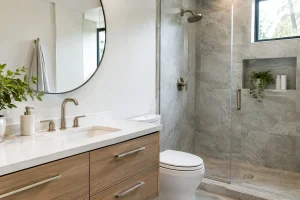

A bathroom can look pristine on the day it is finished, then become a source of chores far sooner than expected. The right low maintenance bathroom finishes make a real difference: fewer grout lines to scrub, less limescale to fight and surfaces that continue to look smart through busy family mornings, muddy dog walks and everyday use.
For many homeowners, practicality is not about settling for a plain or purely functional room. It is about choosing materials that suit the way you live, while still creating a bathroom that feels considered, comfortable and personal. A well-planned finish should be easy to live with as well as pleasing to look at.
What makes a bathroom finish easy to maintain?
A low-maintenance finish is usually smooth, non-porous or well sealed, and fitted with as few unnecessary joins as possible. Water, soap residue and limescale have fewer places to settle, so routine cleaning is quicker and the room stays fresher between deeper cleans.
That does not mean every surface needs to be shiny. Matt finishes can work beautifully, particularly in a softer, more contemporary scheme, but the quality of the material matters. Some very dark matt surfaces and heavily textured tiles can show water marks or hold onto soap residue more readily than a pale, lightly textured alternative.
The best choice depends on your household. A compact en-suite used by two adults has different demands from a family bathroom or a mobility bathroom designed for safe, independent use. During the design stage, it pays to be honest about how much cleaning you want to do and who will be using the space.
Low maintenance bathroom finishes for walls
Large-format porcelain tiles
Porcelain is one of the most dependable choices for bathroom walls and floors. It is hard-wearing, highly water-resistant and available in an enormous range of colours and finishes, including convincing stone, concrete and timber effects. Unlike natural stone, it does not usually need regular sealing.
Large-format tiles are especially useful when easy cleaning is a priority. Because each tile covers more area, there are fewer grout joints across the wall. This creates a calmer, more spacious look and reduces the time spent cleaning grout. In a small Cambridgeshire bathroom, a pale large-format tile can also help the room feel brighter without looking clinical.
There is a practical trade-off. Larger tiles require careful setting-out and skilled installation, particularly on walls that are not perfectly straight. This is not a job to rush, but fitted properly, the result is both durable and easy to maintain.
Bathroom wall panels
Wall panelling is a strong option for shower areas, wet rooms and anyone who would rather not spend weekends scrubbing tile grout. Quality waterproof panels create a smooth, continuous surface with very few joins. Most need only a wipe with a soft cloth and a non-abrasive bathroom cleaner.
Panels are available in marble-look, stone-look, plain matt and gloss designs, so they can feel as refined as tiled walls rather than like a compromise. They are particularly helpful in accessible bathrooms, where reducing cleaning effort and keeping surfaces hygienic can make day-to-day life easier.
The important point is to choose a product designed specifically for wet areas and have it fitted correctly around shower valves, corners and edges. The finish may be low maintenance, but watertight installation is what protects the room behind it.
Moisture-resistant painted walls
Paint still has a place in a bathroom, especially above a tiled or panelled splash zone. It is cost-effective, easy to refresh and gives more freedom with colour than many hard finishes. Choose a good-quality bathroom paint formulated to cope with condensation, and make sure ventilation is doing its job.
Painted walls need more attention than porcelain or wall panels. They can mark, and recurring moisture may lead to peeling if the room is poorly ventilated. For this reason, paint works best away from direct shower spray, paired with an effective extractor fan and a sensible amount of tiled or panelled protection.
Choose flooring that handles real life
Bathroom flooring needs to tolerate splashes while offering enough grip underfoot. It should also work with the level of care you are willing to give it.
Porcelain floor tiles are a reliable long-term choice, particularly in a mid-tone or lightly patterned finish that does not show every water spot. Look for an appropriate slip resistance, rather than choosing solely on appearance. This matters in any home, but it is particularly valuable for young children, older relatives and those planning a bathroom to support future mobility needs.
Luxury vinyl tile can also be a practical choice. It is warmer and softer underfoot than tile, comfortable in a family bathroom and available in convincing wood or stone-effect designs. With a quality waterproof product and professional fitting, it is straightforward to clean. It is not as resistant to sharp impacts as porcelain, so it may not be the best option where heavy objects are likely to be dropped.
Natural stone brings character, but it asks more of the homeowner. Many stone finishes require sealing and periodic care to avoid staining or water damage. If you love the look but not the upkeep, porcelain stone-effect tiles offer a much simpler route.
Keep grout from becoming the difficult part
Even the best tiles can become hard work if the grout is poorly chosen or left unprotected. Pale grout can look crisp, but in a heavily used shower it may show discolouration sooner. A mid-grey or tone-on-tone grout often gives a more forgiving finish without making the design feel dark.
Rectified tiles, which have precisely cut edges, can be installed with narrower grout joints. This gives a clean, modern appearance and leaves less grout exposed to soap and moisture. Narrower does not mean no maintenance, however. Grout still benefits from regular cleaning and a well-ventilated room.
Where possible, avoid tiny mosaic tiles over large areas if easy upkeep is your main goal. Mosaics can be attractive as a feature or shower niche detail, but their many joints make them less convenient on an entire bathroom floor or shower enclosure.
Finishes for showers, screens and fittings
A frameless or minimally framed glass shower screen has fewer awkward channels than a heavily framed enclosure. It creates a lighter look and is easier to wipe down after use. A protective glass coating can help water run off more freely, although it does not remove the need for a quick squeegee in hard-water areas.
When selecting taps and shower fittings, chrome remains a sensible low-maintenance favourite. It is widely available, timeless and generally easier to keep looking clean than highly polished black or brushed brass. That said, a brushed finish can be more forgiving of fingerprints and water marks than a mirror-like surface, so it may suit a busy household better.
Wall-mounted taps and concealed shower valves can make cleaning around the basin and shower area simpler, but they need thoughtful planning before installation. Access for future servicing should never be overlooked for the sake of a sleek finish.
Design for less cleaning, not just better materials
The layout has as much impact on maintenance as the surfaces themselves. A wall-hung vanity leaves the floor visible and accessible for mopping. A basin with a generous deck can collect clutter, while a well-chosen basin and vanity combination provides storage for the products that otherwise gather around the edges.
Shower niches are useful for keeping bottles off the floor, though they should be sized carefully and finished with clean, well-sealed edges. Recessed shelving, mirrored cabinets and practical drawer storage all help reduce visual mess and make cleaning faster.
Ventilation is equally important. An extractor fan sized for the room, used properly, helps control condensation and protects paint, grout, sealant and furniture. No material is truly maintenance-free if the bathroom remains damp long after every shower.
A finish that works for your home
The most successful bathroom is not the one with the fewest cleaning products. It is the one where each choice supports how you want to use the room. A family may benefit from porcelain, wall panels and durable storage. Someone creating a safer bathroom for later life may put slip resistance, easy-access showering and simple-to-clean surfaces first. A couple renovating an en-suite may prefer the calm look of large tiles and a minimal glass screen.
At The Bathroom Magician, the aim is to help homeowners make these decisions before the installation begins, when changes are straightforward and every finish can be considered as part of the whole design. A bathroom should earn its place in your home every day – looking good, working hard and leaving you more time to enjoy it than clean it.