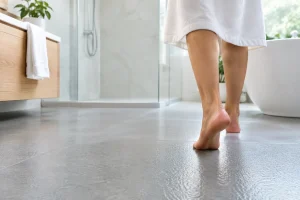

A beautiful bathroom floor should not become a worry the moment it gets wet. This anti-slip bathroom flooring review looks beyond appearances to help you choose a surface that feels secure underfoot, suits the way your household lives and still gives the room the finish you want.
For many homeowners, especially those planning for long-term comfort or improving accessibility, flooring is one of the most consequential decisions in a renovation. It affects daily confidence, cleaning, warmth, drainage and the overall character of the space. The best answer is rarely simply the roughest tile available. It is the right balance of grip, comfort, durability and expert fitting.
What makes bathroom flooring genuinely safer?
Bathroom floors become slippery because water, soap, shampoo and body products form a film on the surface. A floor with useful slip resistance creates more grip between bare feet and the material, even when that surface is damp. Texture helps, but too much texture can make cleaning harder and may feel uncomfortable for bare feet.
You may see anti-slip ratings when looking at tiles. These can be useful as part of the conversation, but they should not be treated as a guarantee on their own. The result underfoot also depends on the tile finish, grout joints, how quickly water drains away, the footwear being worn and how the room is used. A well-designed shower area with proper falls to the drain is just as important as the floor covering itself.
For a family bathroom, think about wet feet after bath time, splashes around the basin and children rushing in and out. For a mobility bathroom, consider stable footing, smooth transitions, space for a carer if needed and a surface that is manageable with walking aids. These details should shape the design from the outset.
Anti-slip bathroom flooring review: the main options
Textured porcelain tiles
Porcelain is often the strongest all-round choice for a fitted bathroom. It is hard-wearing, water-resistant and available in an enormous range of colours and finishes, from soft stone effects to contemporary concrete looks and warm timber-style planks. A matt, textured porcelain tile can provide reassuring grip without making the room feel clinical.
It is particularly well suited to shower areas and wet rooms, where a carefully selected anti-slip finish can be continued across the floor for a coordinated look. Smaller tiles can be helpful in a walk-in shower because the additional grout lines contribute to grip and allow the floor to follow the required drainage gradient more easily.
The trade-off is maintenance. Deeply textured tiles can hold onto soap residue and limescale if they are not cleaned regularly, while pale grout may show discolouration over time. Choosing a practical grout colour and a texture that is comfortable rather than aggressively rough keeps the floor attractive and easier to care for.
Safety vinyl flooring
Safety vinyl is designed with grip in mind and remains a very practical option for bathrooms where confidence underfoot is the priority. It is warmer and softer than tile, generally quieter to walk on and more forgiving if something is dropped. Modern ranges have come a long way from the institutional look some people remember, with convincing stone, tile and wood-effect designs available.
Because it is fitted in large sheets with welded or carefully sealed joins, safety vinyl can create a highly water-resistant surface. This makes it a sensible choice for accessible bathrooms and some wet room designs. It also offers a more comfortable surface for people who spend longer standing at the basin or shower.
Its limitation is that it does not have quite the same premium feel as a well-laid porcelain floor, and sharp objects can damage it. The quality of preparation and installation is crucial. An uneven subfloor will show through, and poorly sealed edges can allow water where it should not go.
Luxury vinyl tile and plank flooring
Luxury vinyl tile, often called LVT, offers a stylish middle ground. It can replicate the warmth of timber or the character of stone, while feeling softer and warmer underfoot than ceramic or porcelain. For a bathroom outside the direct shower zone, quality waterproof LVT can be an appealing choice.
Not every LVT product is suitable for every bathroom, however. Its slip resistance varies by range, and click-fit systems with multiple joints need particular care in rooms exposed to frequent water. It is usually better suited to a standard bathroom floor than a fully tanked wet room or open shower area.
If you love the appearance of wood but want a more practical surface than real timber, LVT deserves consideration. Just make sure the specification is based on the intended use, not simply the sample you liked in a showroom.
Natural stone and stone-effect finishes
Natural stone brings character and a sense of quality that is difficult to copy exactly. Honed or textured finishes can work well in a bathroom, but polished stone should be approached carefully in areas likely to get wet. Stone also needs appropriate sealing and ongoing care, so it is best for homeowners who are comfortable with a little more maintenance.
Stone-effect porcelain often delivers the look with fewer practical demands. It is more consistent, usually easier to clean and available in finishes selected specifically for bathroom safety. In a busy home, this can be the more relaxed choice without sacrificing style.
Resin and microcement-style floors
A resin or microcement-style floor can create a calm, contemporary, almost joint-free finish. It works especially well in modern wet rooms because the visual flow can make a compact space feel larger. The surface can be specified with an anti-slip texture, but this must be agreed at the design stage.
These finishes rely heavily on skilled installation and correct preparation. Cracking, poor adhesion or an overly smooth finish are difficult problems to correct later. They can look exceptional, but they are not a shortcut solution. Ask how the drainage falls, waterproofing and final texture will work together before committing.
Do not separate the floor from the shower design
The safest bathroom floor can still disappoint if water is allowed to spread across it. In a walk-in shower or wet room, the floor needs a carefully planned gradient that guides water to the drain without feeling unstable underfoot. The drain position, shower screen, shower head and tile size all play a part.
A level-access shower is often a good option for people planning to stay in their home for many years. It removes the need to step over a tray and can make the room easier to use for everyone. However, level access does not mean level drainage. The floor construction must be designed properly so water clears efficiently.
This is where a managed bathroom renovation makes a real difference. Flooring, waterproofing, tiling and shower installation should be considered as one system rather than separate jobs for separate trades.
How to choose the right finish for your household
Start with how the bathroom will be used at its wettest. A stylish en-suite used by two adults has different demands from a family bathroom with energetic children, or a mobility bathroom designed to support independence. Consider who uses it, where water lands and how much time you realistically want to spend cleaning.
For a high-use family bathroom, a matt porcelain tile with a modest texture is often an excellent balance of appearance and everyday practicality. For a mobility-focused bathroom or wet room, safety vinyl or suitable small-format porcelain can offer greater assurance, depending on the design. If warmth underfoot is a priority, vinyl and LVT feel more comfortable, while underfloor heating can make tiled floors far more inviting on cold mornings.
It is also worth taking samples home where possible. Look at them in your own light, touch them with wet hands and imagine cleaning them around the toilet and shower. A sample can reveal more than a photograph ever will.
The installation details that protect your investment
No flooring material performs at its best over a poorly prepared base. The subfloor must be sound and level, waterproofing should be correctly applied where required, and tiles need the appropriate adhesive, grout and movement allowance. In wet areas, sealing behind and around fixtures matters as much as the finish you can see.
At The Bathroom Magician, the aim is to make these decisions straightforward: no jargon, no stress. A considered design brings together the surface, drainage, shower solution and finishing details, so the completed bathroom feels safe without looking like a compromise.
The right anti-slip floor should give you confidence every time you step out of the shower, while still making the bathroom a room you enjoy being in. Begin with the way you live, choose a finish that you can maintain comfortably, and make sure the installation is planned as carefully as the design.