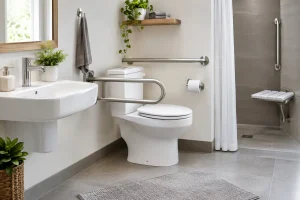

A bathroom can look beautifully finished and still be difficult to use. A towel rail placed just out of reach, a slippery shower floor or a poorly positioned toilet roll holder can turn ordinary routines into awkward ones. The best accessible bathroom accessories are the ones that make the room safer and more comfortable without making it feel clinical.
For homeowners planning to stay in their property for years to come, accessibility is not only about meeting an immediate mobility need. It is sensible, future-focused design. Thoughtful fittings can support independence after an injury, make family life easier and create a bathroom that works well for people of different ages and abilities.
Start with how the bathroom is really used
Before choosing accessories, consider the movements that happen in the room every day. Where does someone need to steady themselves? Do they need to sit while showering, reach toiletries from a seated position or see clearly without glare? Is there enough clear space to turn, dry off and move between the basin, toilet and shower?
These questions matter because the right product in the wrong place will not deliver the benefit you expect. A grab rail beside a shower, for example, should be positioned for the way a person enters, turns and leaves it. It must also be fixed to suitable support behind the wall, rather than simply screwed into plasterboard.
A professionally planned renovation is a good opportunity to deal with these details early. Concealed strengthening, sensible pipework positions and well-judged clearances are far easier to incorporate before tiling and wall panelling are complete. No jargon. No stress. Just a bathroom designed around real life.
Best accessible bathroom accessories for everyday safety
Grab rails that feel secure, not institutional
Grab rails are among the most useful accessibility additions, but they need not resemble hospital fittings. Today’s options include polished chrome, brushed brass, matt black and concealed-fixing designs that suit a contemporary bathroom. Some can double as a towel rail or shower shelf support, although a dedicated rail is often the best choice where substantial weight-bearing support is needed.
The key is to choose a rail with a comfortable diameter, a non-slip grip and a finish that is easy to clean. Vertical rails can help with balance when stepping in or out of a shower. Horizontal rails give useful support when lowering onto or rising from a toilet. Angled rails can provide both functions in one fitting.
Do not rely on suction grab handles as a permanent safety solution. They can be handy for travel or occasional assistance, but they are not a substitute for properly installed rails in a home bathroom.
A fold-down shower seat
Standing in the shower can become tiring, particularly for anyone with reduced balance, joint pain or limited stamina. A fold-down shower seat offers the option to sit without taking up valuable floor space when it is not needed. It is particularly effective in a level-access shower or wet room, where entry is simple and there is no tray edge to negotiate.
A seat should be installed at a suitable height and securely fixed to a reinforced wall. Backrests and arm supports can be worthwhile for some users, but they do make the shower area feel more enclosed. The best choice depends on who will use the space and how much room is available.
A freestanding shower stool may suit a temporary need, but it can move on uneven surfaces and needs to be removed for cleaning. For a long-term solution, a fitted seat is usually safer and neater.
Thermostatic shower controls
A thermostatic shower valve maintains a chosen water temperature even when another tap is used elsewhere in the house. This reduces the risk of sudden hot or cold bursts, making showering more comfortable and safer for children, older adults and anyone with sensitive skin.
Choose lever controls rather than small twisting knobs where grip strength is a concern. Controls positioned near the shower entrance are especially useful, as the water can be started and adjusted before stepping underneath it. A handheld shower head on a height-adjustable rail adds flexibility for seated showering, hair washing and cleaning the enclosure.
Easy-to-use taps
Traditional crosshead taps can look appealing, but they are not always practical for hands affected by arthritis or reduced dexterity. Lever taps are generally easier to operate and can be used with a light touch. A single-lever basin mixer also makes it easier to control flow and temperature with one hand.
For some households, sensor-operated taps are a helpful option. They reduce the need to grip a handle and can minimise drips around the basin. However, they require a reliable power arrangement and may not suit every traditional-style scheme. A well-made lever mixer is often the simplest, most dependable answer.
Toilet accessories that protect comfort and independence
The toilet area deserves as much planning as the shower. A comfort-height WC, which is slightly taller than a standard model, can reduce the effort involved in sitting and standing. It can be paired with a discreet support rail positioned at the correct side and height for the user.
A drop-down support rail is useful where space allows, especially if a person transfers from a wheelchair or needs firmer assistance. It folds neatly against the wall when not in use. Fixed rails are less flexible but can be more straightforward where the layout is tight.
Small details also make a difference. Position the flush plate or handle within easy reach, fit a toilet roll holder that can be accessed without twisting, and allow room for a small shelf or recessed niche for essentials. These are modest decisions during design, yet they can make daily use feel far less demanding.
Lighting, mirrors and storage are accessibility essentials
Poor lighting is one of the most overlooked bathroom hazards. Bright, evenly distributed light around the basin and mirror helps with shaving, skincare, makeup and medication routines. It also makes changes in floor level, wet patches and controls easier to see.
An illuminated mirror with a demister pad is a practical choice, particularly in a family bathroom where the mirror is used straight after showering. Avoid lighting that creates deep shadows around the face or strong glare on glossy tiles. Warm white lighting can feel relaxing, while still giving enough clarity for everyday tasks.
A tilting mirror is useful for people who are seated or shorter in height, allowing the angle to be adjusted without compromise. If the bathroom is used by several people, consider the mounting height carefully rather than simply following a standard position.
Storage should keep frequently used items within comfortable reach. Wall-hung vanity units can provide knee space for a seated user and make the floor easier to clean. Drawers are often more accessible than deep cupboards because the contents can be seen at a glance. Recessed shower niches remove the need to bend down for bottles or balance them on a shower tray edge.
Do not overlook the surfaces underfoot
Accessories work best alongside safe finishes. A non-slip shower tray or properly specified wet room floor is more dependable than relying on a loose bath mat, which can curl or slide. Textured tiles can provide useful grip, though very heavily textured surfaces may be harder to clean.
Wall panelling can also be a practical choice. With fewer grout lines than tiled walls, it is straightforward to maintain and can give a clean, modern appearance. More importantly, suitable backing can be incorporated behind panels where future grab rails may be needed. This is a sensible option for homeowners who want to prepare for the future without fitting every support immediately.
Making accessibility look like part of the design
An accessible bathroom should reflect the rest of your home, not feel like an afterthought. Coordinating finishes across taps, rails, shower frames and accessories creates a considered look. A brushed nickel grab rail beside a matching shower control, for instance, can feel intentional rather than clinical.
The most successful schemes balance present needs with flexibility. A spacious walk-in shower, easy-to-reach storage and good lighting will benefit almost any household. More specialist features, such as a shower seat or drop-down rail, should be selected around the person using them and the available room.
For homes in and around Cambridgeshire, The Bathroom Magician can help bring these decisions together as part of a fully managed bathroom renovation. From layout and product selection to installation and finishing, the aim is a room that is safe to use, easy to maintain and genuinely enjoyable to live with.
A well-designed accessible bathroom does not announce itself every time you walk in. It simply gives you the confidence to get on with your day, comfortably and independently.